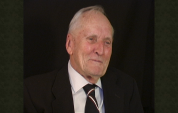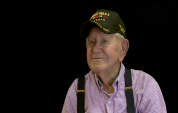
1:58 | Mr. Gaddy explains an accident that took place during rifle training.
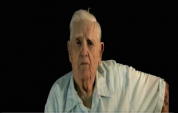
Mr. Gaddy describes his experience of being under shell fire while fighting the Japanese.
Mr. Gaddy explains an accident that took place during rifle training.

Jack Houston had just helped his buddy dress a wound when he volunteered to return to the Okinawa hilltop where they were getting the enemy cleared out. When he got the jump on three of them, his muzzle flash gave him away and he had to leave in a hurry. He flung himself off the hill where he came face to face with a rifle. Part 5 of 6. (This interview made possible with the support of JOHN & BARBARA MCCOY.)
The Russians were close enough that the American POW's could hear the fire in the distance. Their guards roused them all and put them on the road in a forced march, leaving their camp in Poland and heading for Germany. It was seventy nine days of freezing cold out in the open, with very little food. (This interview made possible with the support of PHILIP J. O'NEILL.)
The first operation for the 4th Division was the landing on Roi-Namur. Lawrence Snowden remembers that, though it was an easy victory, valuable combat experience and important lessons were imparted on the Marines.
Two engines were out, a third smoking, and they were were losing airspeed and altitude, but they were flying level and pointed home. Then time ran out for the B-17 and Don Scott had to slip down the hatch into the slipstream. Part 2 of 3.
It was their third mission over Berlin and they were heading home. Four German fighters pounced on the B-24 and it was engulfed in flame and going down. Clyde Burnette fought for consciousness as the other crew in the back of the plane bailed out. He woke in free fall with no idea how he had made it out, and soon he was in German custody. Everyone made it out of the plane except George "Danny" Daneau, the nose turret gunner, who went down with the aircraft.
After a nerve-wracking mission to bomb Tokyo and a typhoon, B.E. Vaughan and the destroyer O'Brien suffered a second kamikaze attack which killed all three of his hometown pals who served with him on board. Then, began the grim task of collecting the personal belongings of the dead and preparing them for burial at sea.
Ed Harrell describes in detail the sinking of the USS Indianapolis from Japanese torpedoes, which left nearly 900 Sailors and Marines in shark-infested Pacific waters. Part 1 of 4.
The Japanese were trying to regroup, but Bill Vaughan's unit had the high ground and took care of them in short order. They had fortified Luzon very well, hiding artillery pieces in caves high in the mountains and rolling them out at night to blast Allied ships. (This interview made possible with the support of MARILYN M. WOODHOUSE.)
During their escape from the Philippines, the men of the USS Quail faced a harrowing voyage on the open sea in their tiny motor launch. Their skipper was highly capable, even devising a homemade sextant. The sun and salt water caused painful blisters on young Lyle Bercier. They were twenty days out and headed for safety in Australia. (This interview made possible with the support of COL ROBERT W. RUST, USMCR (ret.) in honor of LtGen Lawrence Snowden & LtGen George Christmas.)
There was a lot of gunfire during an amphibious landing, recalls Navy gunner P.G. Caudell. One night, they were stuck on a beach and were under the sights of a hidden Japanese artillery piece that was targeting them. (This interview made possible with the support of Vietnam Veteran, Capt. GRAHAM G. KYLE, JR.)
They had to take the hill. Patton needed to cross the Moselle River where the German guns were targeted and Frank "Lindy" Fancher's platoon was pinned down. He was so mad that he grabbed a 30 cal machine gun and some ammo belts and charged the hill. When it was over, the crossing was secure and Fancher had won a battlefield commission. (This interview made possible with the support of RICHARD & BARBARA ROSENBERG.)
As a 20 year old sailor, Lyle Bercier had survived an adventure in a small boat on the open sea, when men from the USS Quail fled the Philippines rather than surrender. Safely ashore in Australia, the Navy tested his mettle in different ways. (This interview made possible with the support of COL ROBERT W. RUST, USMCR (ret.) in honor of LtGen Lawrence Snowden & LtGen George Christmas.)
During one battle, the destroyer USS Radford was guarding some small carriers when a Japanese submarine got in close and sank one. Soon, Hank Sturgess picked up a blip on SONAR and the fast ship closed in to seek revenge. On another occasion, a well known pilot was missing and the men of the Radford joined the search. (This interview made possible with the support of ALBERT SMALL.)
Marine Lieutenant Dan Magill arrived in the Philippines after the enemy was on the run. Very soon, the islands were out from under the thumb of the Japanese, and he had an interesting idea for the colonel about a little commemoration involving a diving exhibition. (This interview made possible with the support of ANITA E. MANUEL.)
His father was a captain in the British Merchant Navy and Jack Litchfield was determined to follow in his footsteps. He left behind the air raids in Liverpool and went to sea as a radioman, but his third voyage turned to disaster when a German torpedo slammed into the freighter.
In 1938, twenty one dollars a month made a real difference. That's what George McLaughlin received when he joined the National Guard. His unit was activated in early 1941 and he rapidly became a very young Master Sergeant. When he was sent to Alaska, it was decided that the tents they were assigned were not adequate, so they milled the lumber to build barracks.
The British prisoners were well treated on board the German cruiser that sank their cargo ship. This came to an end when they were sent to Japan to be imprisoned there. Jack Litchfield watched as the first group of men went down the gangplank and promptly received a beating. When they arrived at the prison camp, the Japanese commander had some sobering words for them.
The amphibious training would go on all night long. Troops would climb down cargo nets into landing craft, then climb back up. P.G. Caudell was a gunner on one of the 26 boats carried by the USS Adair, an attack transport. After passage through the Panama Canal, the Adair began ferrying troops and cargo throughout the Pacific theater. (This interview made possible with the support of Vietnam Veteran, Capt. GRAHAM G. KYLE, JR.)
The classrooms and the headquarters were on different parts of the sprawling University of Georgia campus, so the instructors at the Navy's Pre-Flight School were issued a motorcycle and sidecar to get around. Hal Puett recalls a couple of times that this arrangement went a little sideways. (This interview made possible with the support of T. RICHARD BARBER, JR.)
After going overseas on a troop transport ship, Frank Harris recounts his first mission, his memories over France after D-Day, and the event that led up to his being awarded the Distinguished Flying Cross.
Frank Noonan was trapped with two others below deck on the USS Oklahoma after eight torpedoes ripped into her hull. A savvy junior petty officer figured a way out, but it was no picnic in Pearl Harbor when he broke the surface of the water. Coated with oil and sick from swallowing it, he wondered what his next step would be. Part 2 of 2. (This interview made possible with the support of JANIS HAUSER In Memory Of Alfred W. Hauser, Army Air Corps.)
Navy gunner P.G. Caudell recalls his experience with two hazards to ships in the Pacific, mines and kamikazes. (This interview made possible with the support of Vietnam Veteran, Capt. GRAHAM G. KYLE, JR.)
After returning home to New York, Dave Vogel tried to return to a normal life in the city. One of his favorite memories after returning home was getting invited to Yankee Stadium on a special invite.
Volunteering in the officer's quarters in his town allowed Juergen Tibcken to become much more resourceful and learn valuable skills. Building relationships with these German soldiers was also essential for him and would open opportunities for him down the road.
After the northern part of Okinawa was secured, the Marines of the 22nd Regiment moved south. Jack Houston was sent to be point man for the whole division and he was given two flares. Red if he found nothing, green if he found the enemy. Warily he moved out. Part 1 of 6. (This interview made possible with the support of JOHN & BARBARA MCCOY.)
John Black flew a few gliders during the war and learned about the challenges that come with flying them. After that, he was discharged from the military.
You could trade cigarettes for food in the prison camp, but Jack Litchfield explains why that could be a bad idea. The food supplied by his Japanese captors was meager, but at least it contained something he was very fond of. The men had access to a bath house, though there was not much soap, and it was there that a showering guard uttered something that causes a laugh til this day.
He's not sure, but Nathan Radin thinks he saw some sumo wrestling going on in the Japanese POW camp across the way. He was in New Guinea and his job was to test the loads of fuel tankers for quality and contamination. The men in the unit had to scrounge for the lumber and build the lab themselves, but at least the Japanese never bothered them. (This interview made possible with the support of KETURAH THUNDER-HAAB.)
You were not supposed to have a camera aboard ship, but P.G. Caudell had a miniature novelty camera that he broke down and brought with him anyway. He was wondering if the little thing would work, so he and a buddy gave it a try. (This interview made possible with the support of Vietnam Veteran, Capt. GRAHAM G. KYLE, JR.)
Malhon Shoemake had a sergeant who's gunsmith father sent his son to war with a custom made .45 pistol. As they fought their way across the Pacific, they made good use of "Old Betsy." It was added protection during their souvenir hunts, which were dangerous because of booby traps. (This interview made possible with the support of COL ROBERT W. RUST, USMCR (ret.) in honor of LtGen Lawrence Snowden & LtGen George Christmas.)